Riding a Motorcycle Safely in Jamaica|Essential Motorcycle Safety Tips, Road Hazards and Defensive Riding Practices.

Riding a Motorcycle Safely in Jamaica|Essential Motorcycle Safety Tips, Road Hazards and Defensive Riding Practices.
Introduction.
Motorcycles are an important means of transportation throughout Jamaica, providing affordable, convenient and efficient travel for thousands of Jamaicans. From the busy streets of Kingston and Montego Bay to the winding rural roads of St. Thomas, Portland and St. Elizabeth, motorcycles are widely used for commuting, business activities and personal transportation. However, motorcycle riding presents significant safety risks, particularly when riders encounter hazardous road conditions, speeding vehicles, unsafe overtaking, unexpected obstacles and unpredictable road users.
Riding a Motorcycle Safely in Jamaica requires more than knowing how to operate a motorcycle. It demands defensive riding skills, hazard recognition, sound judgment and a commitment to protecting everyone who shares the roadway.
Why Motorcycle Riding Is Hazardous.
Motorcyclists are among Jamaica’s most vulnerable road users. Unlike occupants of passenger vehicles, motorcycle riders have limited physical protection during collisions. Motorcycles also have smaller profiles, making them less noticeable to other motorists, especially at intersections and during lane changes.Poor road surfaces, inadequate lighting, heavy rainfall and unpredictable traffic movements can further increase the risks. A minor mistake that might result in vehicle damage for a motorist can cause serious injury or death to a motorcyclist.Riders must therefore remain alert, anticipate developing hazards and make safe decisions before dangerous situations occur.
Poor Overtaking and Dangerous Riding Decisions.
Unsafe overtaking is a major motorcycle safety concern on Jamaican roads. Some riders attempt to overtake vehicles near sharp bends, intersections, hills or locations with restricted visibility.Overtaking without adequate sight distance can expose motorcyclists to oncoming vehicles, pedestrians and unexpected roadway hazards.Before overtaking, riders should ensure that the maneuver is lawful, necessary and safe. They must assess approaching traffic, roadway markings, available space and potential escape routes.Never overtake when the roadway ahead cannot be clearly observed or when adequate clearance is unavailable.
Speeding and Loss of Motorcycle Control.
Excessive speed reduces the time available to identify hazards and respond appropriately. It also increases stopping distance and the severity of injuries when crashes occur.On Jamaica’s mountainous and rural roads, speeding becomes particularly dangerous when riders encounter sharp curves, steep gradients, loose gravel and uneven pavement.Motorcyclists should select speeds appropriate for road conditions, visibility, traffic and weather rather than relying exclusively on posted speed limits.Reducing speed before entering curves and maintaining smooth steering, braking and acceleration are essential defensive riding practices.
Potholes and Poor Road Conditions.
Potholes represent a serious hazard for Jamaican motorcyclists, particularly along poorly maintained rural roads and roadways affected by heavy rainfall.Striking a pothole can destabilize a motorcycle, damage its wheels or cause the rider to lose control.Riders should continuously scan the roadway ahead, maintain adequate following distances and avoid sudden steering movements when approaching damaged pavement.When encountering potholes, motorcyclists should reduce speed early and select a safe path without entering opposing traffic or creating additional hazards.
Intersections and Motorcycle Collision Risks.
Intersections are particularly dangerous because vehicles, motorcycles, pedestrians and cyclists may approach from several directions.Drivers may fail to notice an approaching motorcycle or incorrectly judge its speed and distance.Motorcyclists should approach intersections cautiously, observe traffic signals and signs, check for turning vehicles and remain prepared for unexpected movements.A valuable defensive riding practice is to look approximately 12–15 seconds ahead, where conditions permit, to identify developing hazards early.Riders should never assume that another driver has seen them or will automatically yield the right-of-way.
Stray Animals on Jamaican Roads.
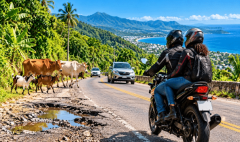
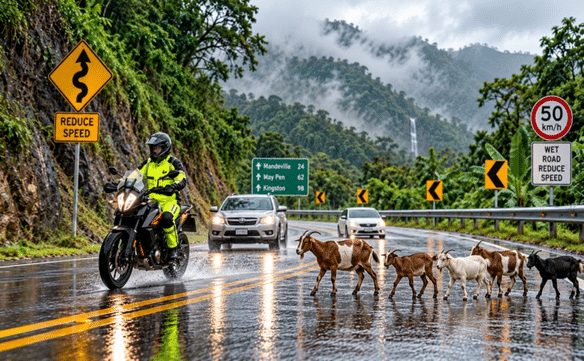
Stray and wandering animals create unpredictable hazards, particularly in Jamaica’s rural communities.Motorcyclists may unexpectedly encounter goats, cattle, horses, dogs and donkeys crossing or standing along the roadway.These animals may suddenly change direction, become frightened by approaching vehicles or move into a motorcycle’s path without warning.For example, a rider traveling along a rural roadway in St. Thomas may encounter cattle emerging from roadside vegetation or goats crossing near a community entrance.Motorcyclists should reduce speed when animals are nearby, increase their following distance and remain prepared to stop safely.Sudden swerving, excessive braking or attempting to accelerate around animals can increase the likelihood of losing control.
Riding Safely with a Pillion Passenger.
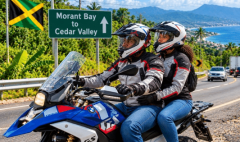
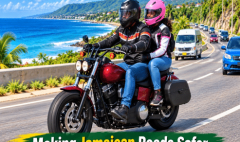
Carrying a pillion passenger introduces additional responsibilities for motorcycle riders.A passenger increases the motorcycle’s combined weight and can affect acceleration, braking distance, balance and handling characteristics.Both the rider and passenger must wear properly fitted, compliant protective helmets and should use appropriate protective clothing.Passengers should sit securely, keep their feet on the passenger footrests, avoid sudden movements and follow the rider’s instructions.Riders should ensure that their motorcycles are designed to accommodate passengers and that tire pressures and suspension settings are appropriate for the additional load.Smooth acceleration, controlled braking and careful cornering become even more important when carrying a pillion passenger.
The Importance of Motorcycle Safety Education in Jamaica.
Improving motorcycle safety requires more than enforcement of traffic laws. Riders must understand how crashes develop, recognize hazardous situations and apply defensive riding techniques consistently.The OSHAccredited Safety Institute has developed Riding a Motorcycle Safely in Jamaica, a comprehensive online motorcycle safety education course designed to strengthen riders’ knowledge, hazard awareness and defensive riding decision-making.The six-hour, self-paced course addresses motorcycle inspections, protective equipment, defensive riding, following distances, overtaking, emergency braking, hazardous road conditions, pillion passenger safety and emergency preparedness.
Through structured learning modules, practical Jamaican roadway scenarios, illustrations and knowledge assessments, participants develop a stronger understanding of the responsibilities associated with safe motorcycle operation.The course complements practical motorcycle rider training by providing essential theoretical knowledge that riders can apply during supervised instruction and everyday riding.
Conclusion: Making Jamaican Roads Safer.
Motorcycle safety in Jamaica depends on responsible riding, continuous hazard awareness and informed decision-making. Speeding, unsafe overtaking, potholes, dangerous intersections, wandering animals and improper passenger practices can all contribute to preventable crashes.By improving their knowledge and adopting defensive riding practices, motorcyclists can reduce their exposure to hazards and help protect other road users.
Enroll:In the OSHAccredited Safety Institute’s Riding a Motorcycle Safely in Jamaicaonline course and take an important step toward safer, more responsible motorcycle riding.
https://oshaccredited.com/courses/
OSHAccredited Safety Institute — Making the Roads Safer.
Author: Dr. O’Neil G. Blake, Chief Executive Officer (CEO) of OSHAccredited Safety Institute
Credentials: MS., MBA., MSc., BSc, CSP., ASP., CSHM., CSMP., MRSA.