Motorbike Safety in Jamaica: Understanding Road Hazards and the Importance of Defensive Riding.

Motorbike Safety in Jamaica: Understanding Road Hazards and the Importance of Defensive Riding.
Introduction.
Motorbike safety in Jamaica is an increasingly important road safety concern as motorcycles continue to provide affordable and convenient transportation across the island. From the busy streets of Kingston and Montego Bay to the winding rural roads of St. Mary, Portland, and St. Thomas, motorcyclists encounter numerous hazards that require constant attention, sound judgment, and defensive riding skills.
Unlike drivers of enclosed vehicles, motorcyclists have limited physical protection during collisions. Road conditions, speeding, dangerous overtaking, unexpected obstacles, and the unpredictable behavior of other road users can quickly turn an ordinary journey into a dangerous situation.Understanding these risks and applying defensive riding principles can help motorcyclists make safer decisions and reduce their exposure to preventable crashes.
Understanding Common Road Hazards in Jamaica.
Jamaica’s road network presents unique challenges for motorcyclists. Potholes, uneven road surfaces, loose gravel, poorly maintained road shoulders, and inadequate drainage can affect motorcycle stability and traction.In urban communities, riders must remain alert for pedestrians, taxis, buses, delivery vehicles, and motorists making sudden stops or unexpected turns. Congested intersections also create situations where drivers may fail to notice approaching motorcycles.Rural roads present additional challenges, including narrow lanes, sharp curves, limited visibility, and vehicles approaching from the opposite direction.Defensive riding requires motorcyclists to recognize these hazards early, reduce speed when necessary, and maintain sufficient space to respond safely.
Speeding and Its Impact on Motorcycle Safety.
Speeding remains one of the most dangerous behaviors associated with motorcycle riding. Traveling at excessive speeds reduces the time available to identify hazards, make decisions, and respond to unexpected situations.Higher speeds also increase stopping distances and the severity of potential collisions.Motorcyclists should adjust their speed according to roadway conditions, traffic density, visibility, and weather conditions. A posted speed limit does not necessarily represent a safe speed when roads are wet, damaged, or congested.Maintaining a controlled speed allows riders to negotiate curves, avoid obstacles, and respond more effectively to changing traffic conditions.
Dangerous Overtaking and Intersection Hazards.
Unsafe overtaking creates significant collision risks, particularly on Jamaica’s narrow rural roads and winding highways.
Motorcyclists should never overtake where their view of approaching traffic is obstructed by hills, curves, parked vehicles, or other obstacles. Before overtaking, riders must confirm that the maneuver is lawful, necessary, and safe.Intersections require similar caution. Motorists may turn across a motorcycle’s path, enter the roadway unexpectedly, or misjudge the rider’s approaching speed.Defensive riders should reduce speed when approaching intersections, scan for conflicting traffic, and remain prepared to brake or take appropriate evasive action.A rider should never assume that another driver has seen the motorcycle or will yield the right-of-way.
Potholes, Loose Gravel, and Unexpected Road Conditions.
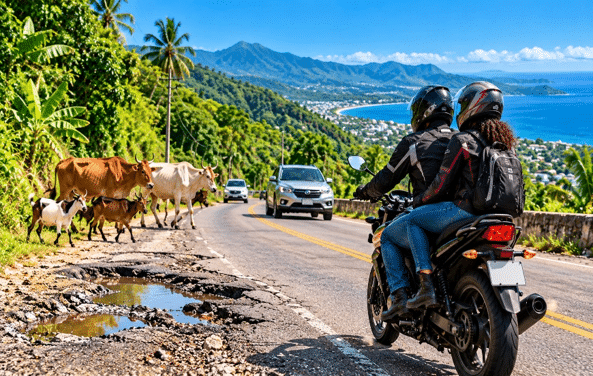
Potholes are particularly hazardous because motorcycles rely on two relatively small tire contact patches for stability.Striking a deep pothole can damage a tire, disturb steering control, or cause a rider to lose balance. Loose gravel, sand, wet pavement markings, and standing water can also reduce traction.Riders should scan well ahead, identify potential escape routes, and avoid abrupt braking or steering movements.When encountering damaged road surfaces, motorcyclists should reduce speed early and maintain smooth, controlled steering and braking inputs.
Stray Animals on Jamaican Roads.
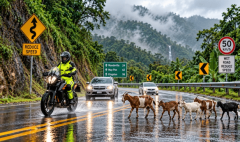
Stray and roaming animals represent another serious hazard, especially in rural communities.Goats, cattle, horses, donkeys, and dogs may unexpectedly enter the roadway, leaving riders with limited time to react.Motorcyclists should exercise additional caution near farms, residential communities, and roads bordered by vegetation.When animals are visible near the roadway, riders should reduce speed, increase their following distance, and prepare for unpredictable movement.Sudden swerving can create additional dangers, particularly when approaching vehicles or roadside obstacles are present.
Protecting Pillion Passengers.
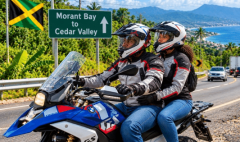
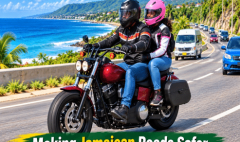
Carrying a pillion passenger increases the responsibility of the motorcycle operator.Additional passenger weight affects acceleration, braking, balance, and handling. Riders must therefore adjust their riding techniques and allow additional time and space for stopping.Both the rider and pillion passenger must wear appropriate protective helmets, and passengers should wear suitable protective clothing and footwear.Passengers should remain properly seated, keep their feet on the designated footrests, and avoid sudden movements that could affect motorcycle stability.
The Importance of Defensive Riding.
Defensive riding is one of the most effective approaches to improving motor bike safety in Jamaica.Motorcyclists should maintain a following distance of at least three seconds under favorable conditions, increasing that distance when road surfaces, visibility, or traffic conditions deteriorate.Riders should also scan approximately 12–15 seconds ahead, check mirrors regularly, identify escape routes, and anticipate potential mistakes by other road users.These practices help motorcyclists recognize developing hazards before emergency action becomes necessary.
Strengthening Motorcycle Safety Through Education.
OSHAccredited Safety Institute recognizes the importance of motorcycle safety education in reducing preventable road crashes.Its online course, Riding a Motorcycle Safely in Jamaica, provides structured instruction covering defensive riding, motorcycle inspections, protective equipment, hazard recognition, emergency maneuvers, high-risk riding behaviors, and Jamaica’s roadway conditions.The course is designed to strengthen riders’ safety knowledge, hazard awareness, and decision-making skills while complementing practical motorcycle training.Motorcyclists, prospective riders, and individuals seeking to improve their road safety knowledge are encouraged to explore this educational opportunity.
Conclusion.
Improving motor bike safety in Jamaica requires responsible riding, greater hazard awareness, and a commitment to defensive riding principles.By controlling speed, avoiding dangerous overtaking, anticipating road hazards, protecting passengers, and pursuing appropriate safety education, motorcyclists can contribute to safer journeys and help protect other road users.
Making Jamaican Roads Safer begins with informed decisions and responsible actions every time a motorcyclist rides.
Course URL: https://oshaccredited.com/courses/
Learn more:OSHAccredited Safety Institute
Author: Dr. O’Neil G. Blake, Chief Executive Officer (CEO) of OSHAccredited Safety Institute
Credentials: MS., MBA., MSc., BSc, CSP., ASP., CSHM., CSMP., MRSA.