Motorcycle Safety in Jamaica | Defensive Riding Tips, Road Hazards & Certification.

Motorcycle Safety in Jamaica | Defensive Riding Tips, Road Hazards & Certification.
Introduction.
Motorcycle safety in Jamaica is an increasingly important road safety concern. From the busy streets of Kingston and Montego Bay to rural communities across the island, motorcyclists face numerous hazards that require awareness, sound judgment, and defensive riding skills. Speeding, dangerous overtaking, poorly maintained roads, unexpected animal crossings, and hazardous intersections can quickly turn an ordinary journey into a life-threatening situation.
Recognizing these challenges, OSHAccredited Safety Institute developed the Jamaica Motorcycle Safety Certification Course, an online educational program designed to strengthen motorcycle safety knowledge, promote responsible riding, and help reduce preventable road traffic collisions.
Motorcycle Accident Statistics: USA, Jamaica, and Worldwide
Motorcycle crashes remain a serious international public safety concern.According to the World Health Organization’s Global Status Report on Road Safety 2023, approximately 1.19 million people die annually in road traffic crashes worldwide. More than half of these fatalities involve vulnerable road users, including pedestrians, cyclists, and motorcyclists.In the United States, the National Highway Traffic Safety Administration (NHTSA) reported 6,228 motorcyclist fatalities in 2024, representing approximately 16% of all traffic deaths. Motorcyclists were nearly 27 times more likely to die per mile traveled than passenger car occupants.Jamaica faces similar challenges. According to Jamaica’s National Road Safety Council, 114 motorcyclists had lost their lives on the nation’s roads by December 2024.These statistics demonstrate why motorcycle safety education, defensive riding techniques, and responsible road behavior are essential.
Maintain a Three-Second Following Distance
One of the most important defensive riding practices is maintaining a safe following distance. Motorcyclists should maintain at least a three-second following distance behind the vehicle ahead under favorable road conditions.To apply this technique, select a stationary roadside object, such as a utility pole or road sign. When the vehicle ahead passes the object, begin counting three seconds. Your motorcycle should not reach that object before completing the count.During heavy rain, reduced visibility, slippery conditions, or poor road surfaces, increase the following distance substantially.A safe following distance provides additional time to recognize hazards, respond to unexpected braking, and avoid collisions.
Look 12–15 Seconds Ahead
Defensive motorcyclists must continuously scan the roadway and anticipate developing hazards.
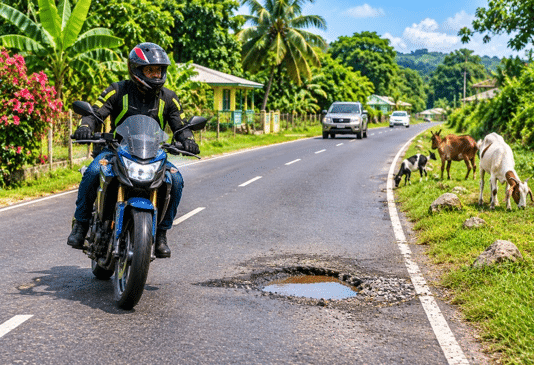
Looking approximately 12–15 seconds ahead helps riders identify intersections, potholes, pedestrians, approaching vehicles, animals, and changing traffic conditions.For example, a motorcyclist approaching a rural Jamaican community may notice goats standing near the roadway. Early recognition allows the rider to reduce speed and prepare for unexpected movement.Effective scanning also involves monitoring mirrors, checking blind spots, and maintaining awareness of surrounding traffic.
Speeding: A Major Motorcycle Safety Hazard
Excessive speed significantly increases the likelihood and severity of motorcycle crashes.Speeding reduces the time available to identify hazards, increases stopping distance, and makes motorcycles more difficult to control during emergency maneuvers.On Jamaica’s winding rural roads, excessive speed becomes particularly dangerous when approaching sharp bends, damaged pavement, or areas with restricted visibility.Motorcyclists should always obey posted speed limits and adjust their speed according to traffic, weather, visibility, and road conditions.A safe riding speed is one that allows the motorcyclist to maintain control and respond effectively to foreseeable hazards.
Intersection Safety and Collision Prevention
Intersections are among the most dangerous locations for motorcyclists because other drivers may misjudge a motorcycle’s speed or fail to recognize its presence.Common intersection hazards include vehicles turning across a rider’s path, drivers failing to yield, pedestrians crossing unexpectedly, and vehicles entering from side roads.Motorcyclists should approach intersections cautiously, reduce speed, when necessary, cover the brakes when hazards develop, and avoid assuming that other drivers have seen them.Even when a rider has the legal right of way, defensive riding requires preparation for another road user’s mistake.
Stray Animals on Jamaican Roads
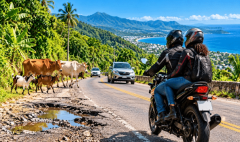
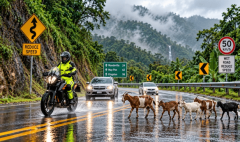
Stray and wandering animals present significant hazards, particularly in rural communities.Goats, cows, horses, dogs, and donkeys may unexpectedly enter the roadway, creating dangerous situations for motorcyclists.A goat may suddenly run across the road, while a cow or horse may occupy an entire traffic lane. Dogs may chase motorcycles, and donkeys may move unpredictably near roadside vegetation.
Riders should reduce speed when approaching animals, maintain a safe escape space, and avoid sudden swerving that could cause a collision with another vehicle.
Potholes and Poor Road Conditions
Potholes, loose gravel, uneven pavement, and damaged road shoulders are additional motorcycle hazards throughout Jamaica.Unlike larger vehicles, motorcycles depend heavily on tire traction and balance. Striking a deep pothole can destabilize the motorcycle and potentially cause a serious crash.Riders should scan ahead, reduce speed before reaching damaged surfaces, and avoid abrupt braking or steering movements.Extra caution is necessary after rainfall because water-filled potholes may conceal dangerous depths.
Dangerous Overtaking and Poor Judgment
Improper overtaking is another significant road safety concern.Attempting to overtake on blind curves, near intersections, approaching hill crests, or where visibility is restricted can result in devastating head-on collisions.Motorcyclists should overtake only where permitted, when the road ahead is clearly visible, and when sufficient space exists to complete the maneuver safely.Riders must never assume that an approaching vehicle will slow down or move aside.
Motorcycle Safety Education and Certification
Developed by OSHAccredited Safety Institute, the Jamaica Motorcycle Safety Certification Course provides structured online education covering defensive riding, motorcycle inspections, protective equipment, emergency maneuvers, hazardous road conditions, and responsible riding practices.The seven-hour course includes nine instructional modules, knowledge checks, and a final examination designed to assess motorcycle safety knowledge.The course supports riders in Jamaica and by strengthening their understanding of hazards and preventive riding strategies.Successful completion demonstrates assessed motorcycle safety knowledge; it does not replace practical rider training or government licensing requirements.
Conclusion
Improving motorcycle safety in Jamaica requires education, responsible decision-making, and consistent application of defensive riding principles.Maintaining a three-second following distance, scanning 12–15 seconds ahead, controlling speed, recognizing animals, avoiding potholes, and overtaking safely can help reduce preventable crashes.Safer motorcycle riding begins with knowledge, awareness, and responsible action.
Explore the Jamaica Motorcycle Safety CertificationCourse, developed by OSHAccredited Safety Institute, and strengthen your motorcycle safety knowledge today.
Visit:https://oshaccredited.com/
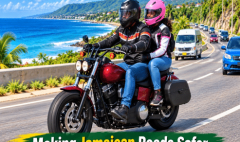
OSHAccredited Safety Institute, Making Jamaican Roads Safer.
Author: Dr. O’Neil G. Blake, Chief Executive Officer (CEO) of OSHAccredited Safety Institute
Credentials: MS., MBA., MSc., BSc, CSP., ASP., CSHM., CSMP., MRSA.