
Road Safety Education in Nigeria: Building Safer Roads Through Defensive Driving Training DDT-6.0 Nigeria

Road Safety Education in Nigeria: Building Safer Roads Through Defensive Driving Training DDT-6.0 Nigeria
Road safety remains a major public-health, transportation, and economic challenge in Nigeria. With millions of motorists, commercial drivers, motorcyclists, pedestrians, and passengers using the nation’s roads every day, effective road safety education in Nigeria is essential for preventing crashes, injuries, and fatalities. OSH Accredited Safety Institute’s Defensive Driving Training DDT-6.0 Nigeria provides drivers with practical defensive-driving knowledge designed to strengthen hazard recognition, improve decision-making, and encourage safer behavior on Nigerian roads.
What Is Road Safety?
Road safety encompasses the policies, behaviors, engineering measures, education, enforcement, and vehicle-safety practices used to reduce the likelihood and severity of road traffic crashes. For drivers, road safety begins with recognizing that operating a vehicle involves constantly changing risks.
A defensive driver does more than obey traffic laws. The driver actively scans the roadway, anticipates mistakes by other road users, maintains adequate following distance, controls speed, avoids distractions, uses seat belts, manages fatigue, and continuously identifies escape options.
This preventive approach is particularly important in Nigeria, where drivers may encounter heavy traffic, commercial vehicles, motorcycles, pedestrians, changing road surfaces, animals, disabled vehicles, and unpredictable behavior during a single journey.
Road Accidents and Fatalities in Nigeria.
The road-safety statistics demonstrate the seriousness of the problem. According to figures released by the Federal Road Safety Corps (FRSC), Nigeria recorded 10,446 road trafficcrashes and 5,289 deaths during 2025. This represented a 9.2% increase in crashes from the 9,570 recorded in 2024. Although fatalities decreased from 5,421 in 2024 to 5,289 in 2025, serious crashes increased by 10.5%, while the number of people injured increased from 31,154 to 33,400. (News Agency of Nigeria).
Earlier National Bureau of Statistics data also demonstrated the scale of the problem. During the second quarter of 2024 alone, Nigeria recorded 2,404 road traffic crashes, including 661 fatal crashes and 1,525 serious crashes. The North-Central region recorded the largest number, with 867 crashes. (National Bureau of Statistics).
These statistics reinforce an important message: improving road safety in Nigeria requires more than responding to crashes after they happen. Prevention must include stronger driver education, defensive driving training, enforcement, vehicle safety, and personal responsibility.
Defensive Driving on Nigeria’s Highways and Rural Roads.
Driving outside major urban centers presents distinctive hazards. Important routes such as the Lagos-Ibadan Expressway, Abuja-Lokoja Road, Abuja-Kaduna-Zaria corridor, Benin-Ore corridor, and Lagos-Abeokuta route carry significant volumes of passenger and commercial traffic. The FRSC specifically maintains corridor commands for several major routes, including Lagos-Ibadan, Abuja-Kaduna-Zaria, Abuja-Lokoja and the Shagamu-Ijebu Ode-Ore-Benin corridor. (FRSC).
Historical FRSC route analysis also demonstrates why defensive-driving skills are-important on these corridors. In 2022, for example, the Lagos-Ibadan Expressway recorded 803 crashes and 257 fatalities, while Abuja-Lokoja recorded 596 crashes and 249 fatalities. (FRSC).
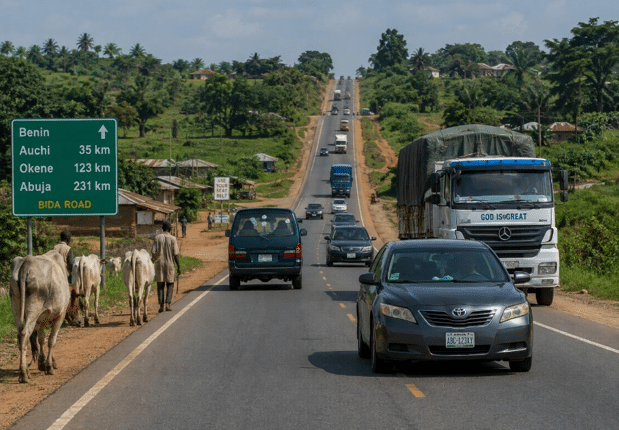
Rural driving can introduce additional hazards. Drivers may encounter potholes, deteriorated pavement, poor lighting, limited road markings, pedestrians, motorcycles, slow-movingvehicles,roadside activities, cattle, goats and other animals entering the roadway.
A defensive driver should therefore avoid assuming that an apparently open rural highway is automatically safe for higher speeds. Drivers should scan well ahead, reduce speed when visibility or road conditions deteriorate, maintain space around the vehicle, and remain prepared for unexpected hazards.
Speeding and Poor Overtaking.
Speeding reduces the time available to identify and respond to hazards while increasing stopping distance and crash severity. A safe speed is not simply the maximum speed permitted by a sign. Drivers must adjust their speed for traffic, visibility, weather, road conditions, pedestrians, animals and other hazards.
Poor overtaking is another serious road safety concern. Attempting to overtake when sight distance is inadequate, overtaking multiple vehicles without sufficient space, misjudging approaching traffic, or forcing another driver to take evasive action can produce catastrophic head-on and sideswipe collisions.
DDT-6.0 Nigeria emphasizes evaluating the roadway before overtaking and abandoning the maneuver whenever a safe outcome cannot reasonably be assured.
Seat Belts Save Lives.
Seat-belt use is one of the simplest and most effective protective measures available to vehicle occupants. Every driver and passenger should be properly restrained whenever the vehicle is moving, regardless of whether the journey is across a city or only a short distance through a community.
Professional drivers also have an important leadership role. Consistent seat-belt use helps establish a safety culture in commercial fleets and reinforces the principle that safe driving begins before the vehicle moves.
Safe Lane Changes.
Lane changes require deliberate observation and planning. Before changing lanes, drivers should check mirrors, activate the turn signal for at least two seconds, assess surrounding traffic, check the blind spot, confirm adequate space, and make one smooth and decisive movement into the new lane.
Sudden lane changes, failure to signal, weaving between vehicles, and moving without checking blind spots significantly increase collision risk, particularly in congested traffic and around motorcycles.
Following Distance: Protect Your Safety Space.
Maintaining adequate following distance provides drivers with time to perceive a hazard, decide what to do, and respond safely.
DDT-6.0 Nigeria teaches the following practical minimum guidelines:
- Passenger cars: at least 3 seconds.
- Commercial vehicles in towns and residential areas: at least 4 seconds.
- Commercial vehicles on highways: 7–10 seconds.
These distances should be increased when conditions become unfavorable, including rain, poor visibility, heavy traffic, damaged roads, nighttime driving, or when following motorcycles and unpredictable vehicles.
For professional drivers, the 7–10 second highway following distance is particularly important because larger vehicles generally require more distance to slow or stop safely.
Fatigue Management: Rest Before Fatigue Controls the Driver.
Fatigue can reduce concentration, reaction time, judgment, visual awareness, and decision-making ability. Long-distance commercial and passenger transportation makes fatigue management especially important for road safety in Nigeria.
DDT-6.0 Nigeria encourages drivers to plan rest into their journeys rather than waiting until exhaustion becomes severe. As a practical defensive-driving strategy, drivers should consider taking approximately a 15–20-minute break after every two hours of driving, while recognizing that a driver who becomes tired or drowsy earlier should stop sooner.
Opening a window, increasing music volume, or relying on stimulants should never be treated as substitutes for adequate rest.
Improving Road Safety Education in Nigeria Through DDT-6.0 Nigeria.
Reducing Nigeria’s road traffic crashes requires a shift from reactive driving to risk-based defensive driving. Drivers must learn not only how to operate vehicles, but how to recognize developing hazards before those hazards become emergencies.
OSH Accredited Safety Institute’s Defensive Driving Training DDT-6.0 Nigeria supports this objective by strengthening hazard recognition, safe following practices, speed management, lane-change procedures, overtaking decisions, fatigue management, distraction awareness, and other essential defensive-driving behaviors.
For individual motorists, commercial drivers, fleet operators, employers, transportation organizations, and institutions seeking stronger road safety education in Nigeria, DDT-6.0 Nigeria provides a structured approach to developing safer driving decisions.
Nigeria’s road-safety statistics demonstrate that prevention remains urgently important. Every driver who slows down, wears a seat belt, maintains adequate following distance, avoids dangerous overtaking, manages fatigue, checks blind spots, and anticipates hazards contribute to safer roads.
Defensive Driving Training DDT-6.0 Nigeria is therefore more than driver educationit is an investment in safer drivers, safer fleets, safer communities, and a stronger road-safety culture across Nigeria.
Author: Dr. O’Neil G. Blake, Chief Executive Officer (CEO) of OSHAccredited Safety Institute
Credentials: MS., MBA., MSc., BSc, CSP., ASP., CSHM., CSMP., MRSA.